


AI SEO: If you run a website, market a business, or create content, you’ve likely noticed that the ground beneath your feet is shifting. The era of traditional search engine optimization is rapidly transforming into a landscape dominated by artificial intelligence.
AI SEO is no longer a futuristic concept—it is the active reality of digital marketing. The destination for our content has changed: instead of only competing for a standard blue link, we are now competing to be the precise source an AI system extracts, synthesizes, and quotes.
This comprehensive guide breaks down exactly what artificial intelligence seo looks like right now, how to adapt your content strategy, and how to stay ahead of the curve using the right framework and best AI tools for seo.
If you’re also using automated workflows in your business beyond search engines, our guide to using AI agents for small business pairs perfectly with this strategy.
What Is AI SEO?
AI SEO is the strategic practice of optimizing your digital content so it ranks highly in traditional search results while simultaneously being retrieved, summarized, and cited by AI-powered answers engines like Google AI Overviews, AI Mode, ChatGPT Search, Perplexity, Claude, and Gemini.
It combines classic technical and content optimization with two newer, crucial disciplines:
- Generative Engine Optimization (GEO): Optimizing content specifically for large language models (LLMs) to synthesize into their responses.
- Answer Engine Optimization (AEO): Crafting content to be served as the immediate, direct answer to targeted user queries.
If you have spent years building your traditional search skills, you aren’t starting over. SEO with AI builds on the same core pillars of technical health, authoritative signals, and deep quality that have always mattered. What has changed is how search engines read, parse, and credit that information.
Why AI SEO Matters Right Now

The evolution of search is showing up directly in traffic data and search engine results pages (SERPs). How AI is changing SEO is best observed through adoption metrics:
- Google AI Overviews Expansion: Google’s AI answers have grown from a limited experiment to appearing on more than 48% of total Google Search queries as of March 2026, up from roughly 6.5% a year prior. That means nearly half of all searches present a synthesized, machine-generated block before a user ever sees a standard organic listing.
- The Click-Through Advantage: Pages actively cited inside Google AI Overviews earn roughly a 35% increase in organic clicks compared to non-cited competitors ranking at the exact same position.
- The Fragmentation of Search Traffic: A large-scale analysis of 680 million citations across ChatGPT Search, Google AI Overviews, and Perplexity revealed that only about 11% of domains are cited by both ChatGPT and Perplexity.
Optimizing for “AI search” as if it is a single monolithic engine is an operational mistake. Each AI platform uses unique retrieval pipelines, source preferences, and trust parameters.
How AI Search Actually Works
Before building an AI SEO strategy, you must understand the mechanics happening behind the user interface. Most modern AI search tools rely on Retrieval-Augmented Generation (RAG). Instead of answering a query purely from static, memorized training data, the engine runs a live search to pull web documents relevant to the prompt, then uses an LLM to synthesize a natural response grounded in those live sources.

For Google, this relies heavily on a process called “query fan-out.”
How AI affects Google rankings: Google expands a user’s initial search query into multiple related sub-queries, retrieves top documents across those distinct topical clusters, and then assembles one consolidated response supported by multi-source.
Google’s official developer documentation states clearly that there are no additional technical requirements to appear in AI Overviews or AI Mode beyond fundamental SEO best practices. High-quality, uniquely helpful, well-structured content still does the heavy lifting.
However, engines handle data discovery differently:
- ChatGPT Search: Draws on a combination of Bing’s index, specialized partnerships, and OpenAI’s proprietary web crawlers. For many queries, it may reply entirely from its training corpus without performing a live search.
- Perplexity: Systematically performs a real-time web search for almost every query, retrieving 5 to 10 candidate web pages, re-ranking them dynamically, and distilling them down to 3 or 4 clear citations.
If you want to understand how the underlying models powering these systems differ in reasoning, our detailed Claude AI 3.7 Sonnet review and Gemini AI Assistant breakdown go much deeper.
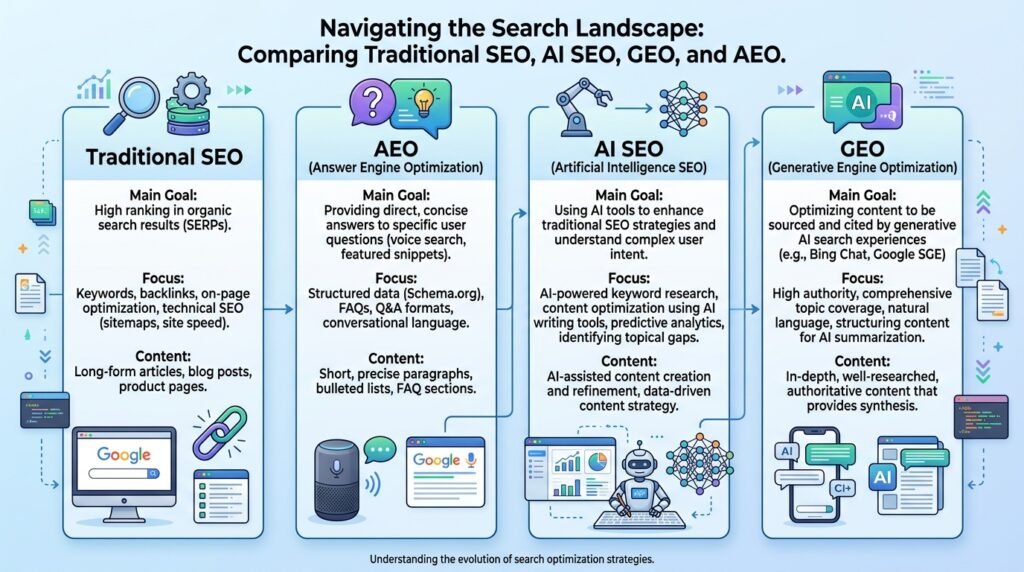
AI SEO vs. GEO vs. AEO vs. Traditional SEO
These terms are frequently used interchangeably, but they represent distinct goals in the modern search ecosystem.
Search Disciplines Compared
| Discipline | Primary Goal | Where It Applies | Key Success Metric |
| Traditional SEO | Rank a URL in the standard blue links list | Google, Bing organic listings | Keyword rankings, organic organic clicks, impressions |
| AEO (Answer Engine Optimization) | Get selected as the single, direct answer | Featured snippets, voice search, AI Overview headers | Answer snippet share, “Position Zero” |
| GEO (Generative Engine Optimization) | Get cited or synthesized inside an LLM answer | ChatGPT Search, Perplexity, Claude, Gemini | Citation rate, “Share of Model” |
| AI SEO | The holistic umbrella strategy combining all three | Every search and AI conversational interface | Combined brand visibility across all search layers |
What the Research Says: Inside the Princeton GEO Study
Most optimization advice on the web is guesswork. However, a landmark academic study conducted by researchers from Princeton, Georgia Tech, IIT Delhi, and the Allen Institute for AI (later presented at the ACM KDD 2024 conference) analyzed over 10,000 queries to isolate what actually drives visibility in generative engines.

The data revealed definitive content adjustment strategies:
- Cite Authoritative Sources: Adding external citations to primary sources improved visibility by roughly 115% for lower-ranked domains.
- Integrate Hard Statistics: Incorporating verifiable, data-backed statistics into the body copy boosted generative engine visibility by around 41%.
- Use Direct Quotations: Incorporating explicit, impactful quotes from industry experts improved citation rates by about 28%.
- The Position 5 Sweet Spot: Pages sitting around position 5 in organic search benefited the most from these GEO techniques, achieving visibility gains near 115%, whereas pages already sitting comfortably at position 1 saw minimal additional layout shifts.
The study proved that optimization tactics must match the query intent. Adding statistics works best for analytical, financial, or legal topics; adding expert quotes performs best for historical, cultural, or explanatory search queries.
E-E-A-T: The Foundation AI Systems Still Reward
Google’s core framework of Experience, Expertise, Authoritativeness, and Trustworthiness (E-E-A-T) has become the ultimate filter for AI algorithms. Because RAG systems cross-reference facts across multiple websites, contradictory, thin, or unverified claims are filtered out entirely.

Data indicates that pages with clearly credited expert authorship are roughly 3.2 times more likely to be cited in AI Overviews than general, unattributed, staff-written content.
Practical E-E-A-T Checklist for AI Optimization
- Show Firsthand Experience: Embed unique case studies, original screenshots, video walkthroughs, and proprietary data that AI scrapers cannot easily replicate.
- Provide a Clear Expert Byline: Link author profiles to transparent bio pages detailing real-world credentials, certifications, and portfolios.
- Link to Primary Data: When citing laws, data points, or news, link directly to official .gov, .edu, or corporate press releases rather than secondary blogs.
- Maintain Freshness: Stale dates and outdated figures cause rapid de-indexing in real-time lookup engines like Perplexity. Keep your core data evergreen.
How to Structure Content for AI Extraction
Generative engines do not scan your website like a human reader; they parse text blocks for highly extractable data segments. Structure is your core retrieval mechanism.

The 40–60 Word Rule
Whenever you introduce a vital conceptual heading or answer an interrogative query (Who, What, Why, How), provide a direct, concise summary of 40 to 60 words immediately below the sub-headline. This gives the language model a clean, self-contained text snippet it can easily extract and drop straight into an AI Overview or chat window.
Structural Element Optimization
To succeed in SEO in the AI era, ensure your content layout adopts these formatting choices:
- Tabular Data: Deploy clean comparison tables. LLMs parse tables exceptionally well for structured side-by-side analysis.
- Procedural Steps: Use ordered numbers (
1., 2., 3.) for tutorials and bullet points (*) for listicles. - Modular Paragraphs: Keep sections short and focused on a single thematic entity.
- Unambiguous Naming: Avoid vague pronouns. Say “Google AI Overviews SEO” instead of “this search update”.
Technical AI SEO: Crawlers, Schema, and llms.txt
The technical side of artificial intelligence seo requires stripping away myths and focusing on true crawlability.

The Truth About Schema and AI Files
Google has been transparent: schema.org markup is highly recommended for structured context (like Organization, Article, or Product data), but it is not a prerequisite or a secret pass to win AI citations.
Furthermore, Google completely retired FAQ rich results from search engine result pages as of May 7, 2026. While maintaining FAQPage schema will not break your code or hurt your rankings, it will no longer generate specific custom search drop-downs on Google. Keep the FAQ text visible for your users and AI parsers, but do not dedicate development hours to chasing legacy FAQ rich results.
Essential Technical Checklist
- Audit Your Robots.txt: Ensure you are not accidentally blocking the specific user-agents powering modern AI search engine indices:
Googlebot/Googlebot-Image(Google AI Overviews)GPTBot/OAI-SearchBot(ChatGPT Search)PerplexityBot(Perplexity)ClaudeBot(Claude / Anthropic)
- Optimize Load Speed: Real-time retrieval engines fetch, render, and extract your live page content during a user conversation. Slow rendering speeds mean your page gets skipped in the processing loop.
- Leverage llms.txt (Optional): You can host a lightweight
/llms.txtfile at your root directory to provide a clean, markdown-formatted directory of your site’s main content for AI crawlers, though treat it as an experimental extra, not a core technical requirement.
Off-Page Signals: Brand Mentions, Reddit, and Consensus
AI search optimization completely shifts the focus of traditional off-page SEO away from simple backlink profiles toward what digital marketers call the “consensus signal.”

Before an AI engine recommends your product or cites your guide, it scans the broader web to verify if independent sources agree with your claims. If your brand name is consistently discussed across forum threads, community channels, video channels, and high-authority publications with similar context, the LLM’s confidence metric spikes.
Forum indexing has grown exponentially. Quantitative analysis shows that across fifty major transactional queries, Reddit stands as the single largest cited entity, capturing roughly 40% of aggregated community references across leading AI search systems. Real brand visibility now demands authentic digital PR, organic forum discussions, and comprehensive third-party reviews.
Platform-by-Platform Playbook
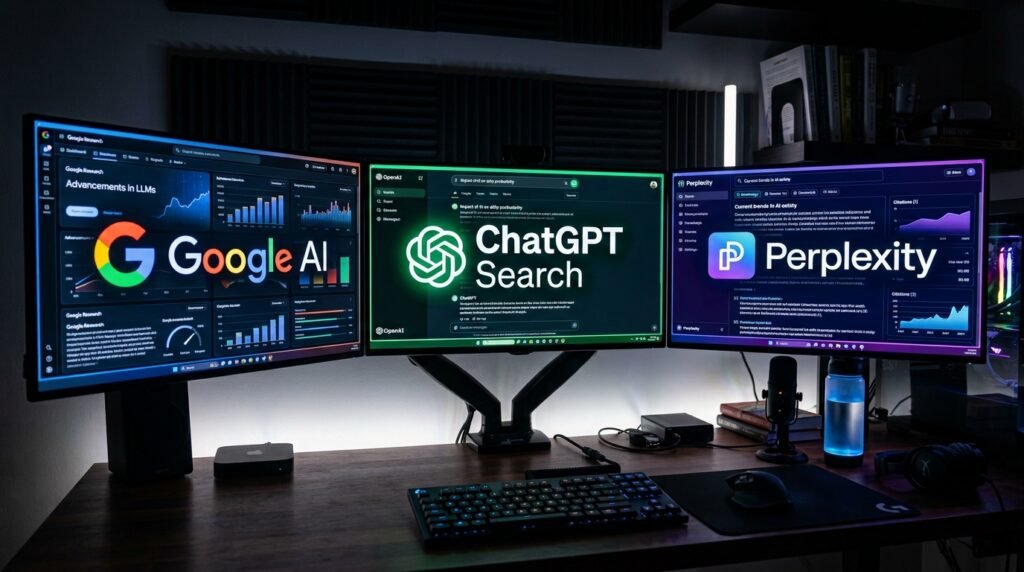
To effectively target your audience, customize your approach for the unique architectures of the best AI tools for seo:
Google AI Overviews & AI Mode
- Core Tactic: You must rank organically well in traditional search first. Google primarily pulls its AI context from top-page results.
- Execution: Rely heavily on deep E-E-A-T compliance and provide high-value, direct summaries right beneath your H2 and H3 subheadings.
ChatGPT Search
- Core Tactic: ChatGPT relies significantly on Wikipedia presence, major digital PR placements, and established global editorial databases.
- Execution: Build strong third-party brand validation. Because ChatGPT regularly defaults to answers directly out of its training data corpus without live lookups, consistent long-term brand equity is critical.
Perplexity
- Core Tactic: Perplexity places immense weight on data recency, real-time factual correctness, and extractable evidence blocks.
- Execution: Update your core landing pages frequently. Keep site speeds optimized so Perplexity’s parser can instantly scan your page during active user prompts.
If you are currently deciding on which tools to integrate into your production workflow to scale your research and layout building, see our comparisons on ChatGPT vs. DeepSeek and our vetted list of alternative AI tools that outperform ChatGPT.
How to Measure AI SEO Performance

Standard rank tracking software cannot adequately monitor conversational outputs. You must expand your analytics stack to observe performance across these core metrics:
Modern AI Visibility Metrics
| Metric | What It Measures | Where to Find It |
| Citation Rate | The percentage of relevant conversational prompts where your URL is cited as a source | Manual testing logs, specialized GEO visibility tools |
| Share of Model (SoM) | How frequently your brand or site is listed compared to competitors when an LLM speaks about your industry niche | Emerging GEO analytics platforms |
| AI Referral Traffic | Direct traffic sessions arriving at your site from chatgpt.com, perplexity.ai, or gemini.google.com | Google Analytics (Referral Traffic Reports) |
| Generative AI Performance | Clicks and impressions generated purely from Google’s native AI interfaces | Google Search Console (rolling out globally) |
While Google Search Console’s staggered rollout of generative search reporting continues, running consistent manual checkups across target user queries remains highly effective for tracking real-world citation status.
A Step-by-Step AI SEO Framework You Can Use Today
- Baseline Your Generative Footprint: Run your 5 most critical business queries across Google AI Mode, ChatGPT Search, and Perplexity. Document which competitors appear and analyze their structural text patterns.
- Verify Crawl Settings: Confirm your
robots.txtconfiguration explicitly allows access toOAI-SearchBot,PerplexityBot, andGooglebot. - Execute Content Structuring: Re-write the top sections of your most valuable landing pages using the 40–60 word rule to create instant extraction opportunities.
- Inject Data and Sourced Quotes: Review your text content to inject hard numbers, proprietary statistics, and attributed industry expert opinions.
- Audit Author Transparency: Build clean, visible author text blocks with clickable resource links back to transparent professional profiles.
- Monitor Monthly: Track your incoming AI referral traffic trends inside your analytics dashboard and adjust your text formatting to stay accurate.
Frequently Asked Questions
What are the best AI SEO tools for beginners?
If you want to introduce software to analyze search patterns, track citations, or optimize content loops, consider using these specialized ai seo tools:
- Frase: Ideal for outlining content structures that mirror high-ranking patterns.
- Surfer SEO: Excellent for real-time content optimization guides and tracking target entities.
- MarketMuse: Advanced platform for auditing semantic gaps and managing content topical authority.
- Semrush: A classic powerhouse suite that includes specialized tracking features for featured snippets and modern AI search layouts.
What is the core difference between GEO and SEO?
Traditional SEO focuses on adjusting a webpage’s keyword usage, links, and speed to secure a spot on a static list of blue links. GEO (Generative Engine Optimization) focuses on optimizing the layout, formatting, citations, and data density of a page so a large language model can successfully pull it to build a synthesized answer.
Will AI search engines eliminate organic website clicks?
No. Empirical data demonstrates that receiving a highly relevant citation inside a conversational result provides a definitive visibility boost, sending deeply qualified, high-intent traffic to your website.
Does an llms.txt file help improve rankings?
No major AI developer has stated that hosting an llms.txt file alters your semantic ranking score. It serves as a helpful roadmap for scraper bots, but it will never replace the impact of high-quality, long-form content writing.
Conclusion
AI search optimization isn’t an entirely new digital universe; it is a natural extension of search engine optimization. The businesses winning the visibility game are simply executing core fundamentals at a high level while respecting new machine-reading layout structures: direct answers, transparent expert backgrounds, verified hard statistics, and clear formatting.
Take proactive steps today: pick three of your most critical conversion pages, format their introductory sections for clean data extraction, add verified sources, and monitor your referral metrics over the coming weeks.
Stay ahead of the curve by continually exploring our deep technical resource libraries on GPTInfos. If you found this strategic breakdown useful, share it with a colleague who is still optimizing their business for a search architecture that no longer exists in isolation.
External References
This article draws on the following primary and secondary sources. Facts and statistics are attributed accordingly; always verify time-sensitive figures against the original source before republishing.
- Google Search Central — AI Features and Your Website (official documentation)
- Wikipedia — AI Overviews
- Princeton University — GEO: Generative Engine Optimization (Aggarwal et al., ACM KDD 2024)
- 321 Web Marketing — Where and Why Google’s AI Overviews Appear
- SEO-Kreativ — Optimize for Google AI Overviews: Step-by-Step 2026
- Blue Glass Insights — Google Search Central: The Complete Guide to Google’s Official SEO Documentation
- La Teva Web — How to Appear in Google AI Overviews?
- Niumatrix — Getting Featured in Google AI Overviews: A Step-by-Step Guide
- Digital Applied — GEO Guide 2026: Generative Engine Optimization Explained
- Digital Applied — Structured Data After I/O 2026: Schema Cheat Sheet
- Sunil Pratap Singh — What GEO Research Actually Says: Princeton to SparkToro
- Geoptie — Generative Engine Optimization (GEO): The Definitive Guide 2026
- The GEO Community — The Original GEO Paper: Princeton & IIT Delhi Study Findings Explained
- Idea Digital Agency — How to Get ChatGPT, Perplexity, and Other AI Tools to Cite Your Website
- Leapd — How ChatGPT, Google AI Overviews, and Perplexity Source Information in 2026
- AI Labs Audit — How to Get Cited by Perplexity AI in 2026
- Sapt — AI Search Optimization: How to Get Cited by ChatGPT, Perplexity & Google AI
- PingPrime — ChatGPT Search vs Google AI Overviews vs Perplexity: The 2026 Guide
- Pravin Kumar — Perplexity vs ChatGPT vs Google AI Mode: Where Each AI Cites Different Sources
- Authority Tech — How Perplexity Decides Which Sources to Cite
- Discovered Labs — AI Citation Patterns: How ChatGPT, Claude, and Perplexity Choose Sources
- Quattr — FAQ Schema in 2026: What’s Confirmed, What’s Not & What to Do
- GW Content — Structured Data for SEO: A Guide to Schema Markup in 2026
This article is for informational purposes and reflects publicly available research and documentation current as of July 2026. AI search platforms update their systems frequently — always confirm time-sensitive claims (especially statistics and platform behavior) against the linked primary sources before making major strategic decisions.

Meta Description: Learn how AI SEO, GEO, and AEO work in 2026.)